Latissimus dorsi
The latissimus dorsi is a broad, flat muscle of the back that arises from the lower six thoracic spines, the thoracolumbar fascia, the iliac crest and the lower ribs. It inserts on the floor of the intertubercular groove of the humerus and draws the arm down, back and inward, supplied by the thoracodorsal nerve.
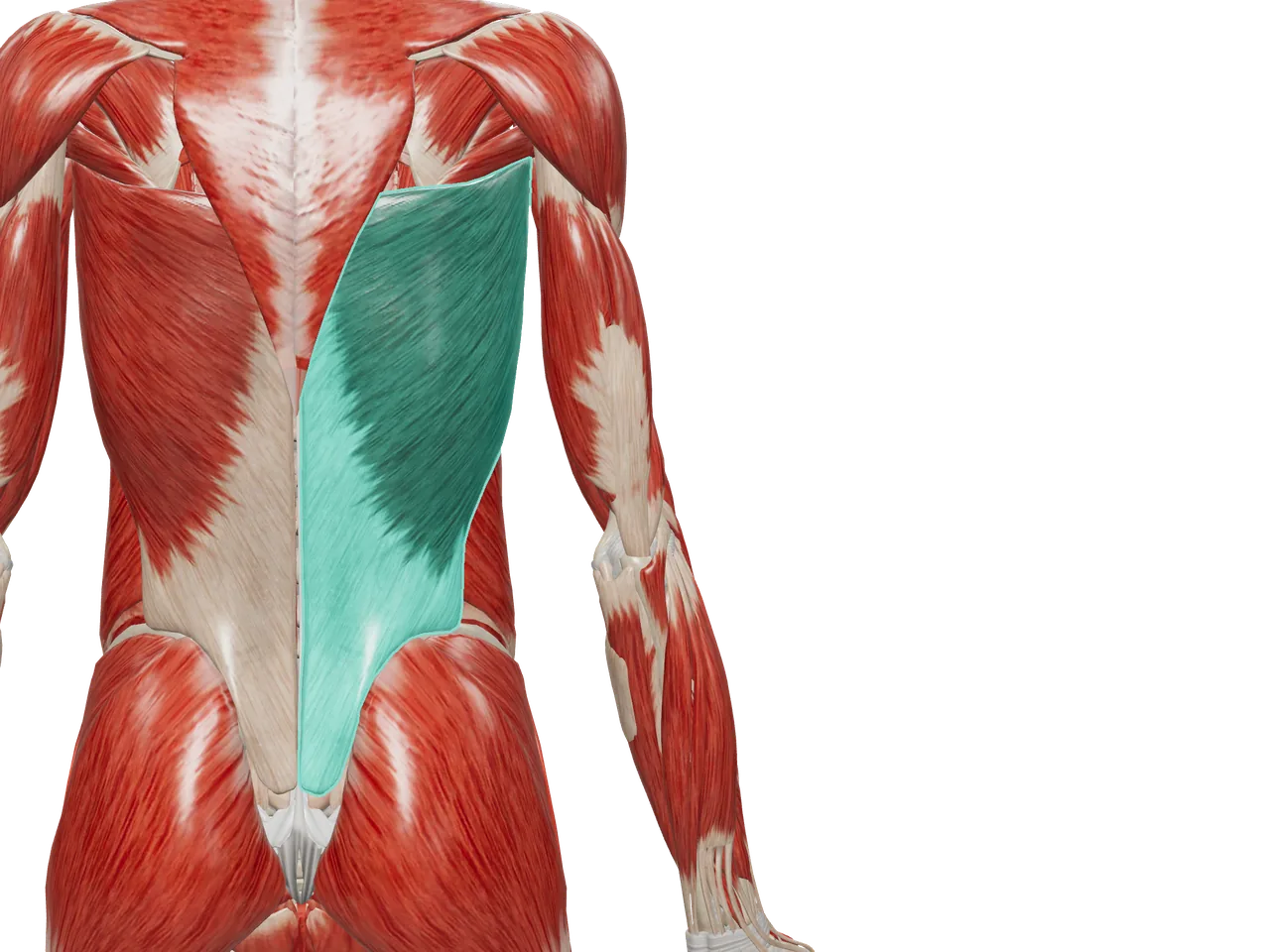
A structure in the 3D atlas. The facts below are the ones Watar holds for it, each with its source.
Facts
- A broad, flat triangular muscle of the back. It arises by tendinous fibres from the spinous processes of the lower six thoracic vertebrae and from the posterior layer of the lumbodorsal (thoracolumbar) fascia, which carries it to the lumbar and sacral spines, the supraspinous ligament and the back of the iliac crest.
- It also arises by muscle fibres from the external lip of the iliac crest lateral to the sacrospinalis and by fleshy slips from the lower three or four ribs, interdigitating with external oblique. Its fibres converge, cross the inferior angle of the scapula and usually take a few fibres from it.
- The fibres end in a flat four-sided tendon about 7 cm long that passes in front of the teres major tendon and inserts into the bottom of the intertubercular groove of the humerus.
- Acting on the humerus it draws the arm down and backward and rotates it medially. With both arms fixed, as in climbing, the two muscles help the abdominal muscles and pectorals pull the trunk forward.
- Supplied by the thoracodorsal nerve (Gray also calls it the long subscapular nerve), with fibres from C6, C7 and C8.
- Thoracodorsal artery, to latissimus dorsi and to the lower portion of serratus anterior.
- It arises by tendinous fibres from the spinous processes of the lower six thoracic vertebrae and from the posterior layer of the lumbodorsal (thoracolumbar) fascia, which carries it to the lumbar and sacral spines, the supraspinous ligament and the back of the iliac crest.
- The fibres end in a four-sided tendon about 7 cm long that passes in front of the teres major tendon and inserts into the bottom of the intertubercular groove of the humerus.
- Spinous processes of the lower six thoracic vertebrae; the lumbodorsal fascia (posterior layer), which links it to the lumbar and sacral spines, the supraspinal ligament and the back of the iliac crest; lower 3-4 ribs, interdigitating with external oblique; inferior angle of the scapula.
- Fibres end in a flat tendon about 7 cm long, which winds in front of the teres major tendon and attaches to the floor of the intertubercular groove of the humerus.
- Adducts and medially rotates the humerus, working with teres major and pectoralis major; also extends the humerus, again with teres major.
- Active in deep inspiration and in forceful breathing such as coughing and sneezing. With the arms fixed overhead (climbing, a chin-up) it pulls the trunk up and forward. Evidence is mixed on any contribution to spinal extension, lateral flexion or rotation.
- Thoracodorsal nerve, also called the long subscapular nerve. Roots C6-C8, with C7 predominant; it comes off the posterior cord of the brachial plexus.
Sources
- Gray's Anatomy, 1918
- StatPearls: anatomy-thorax-serratus-anterior-muscles
- StatPearls: Anatomy, Back, Latissimus Dorsi