Biceps brachii
The biceps brachii has two heads on the front of the upper arm, and its distal tendon, the bicipital aponeurosis, attaches to the radial tuberosity and the forearm fascia. It flexes the elbow and, once the forearm is flexed, is its strongest supinator.
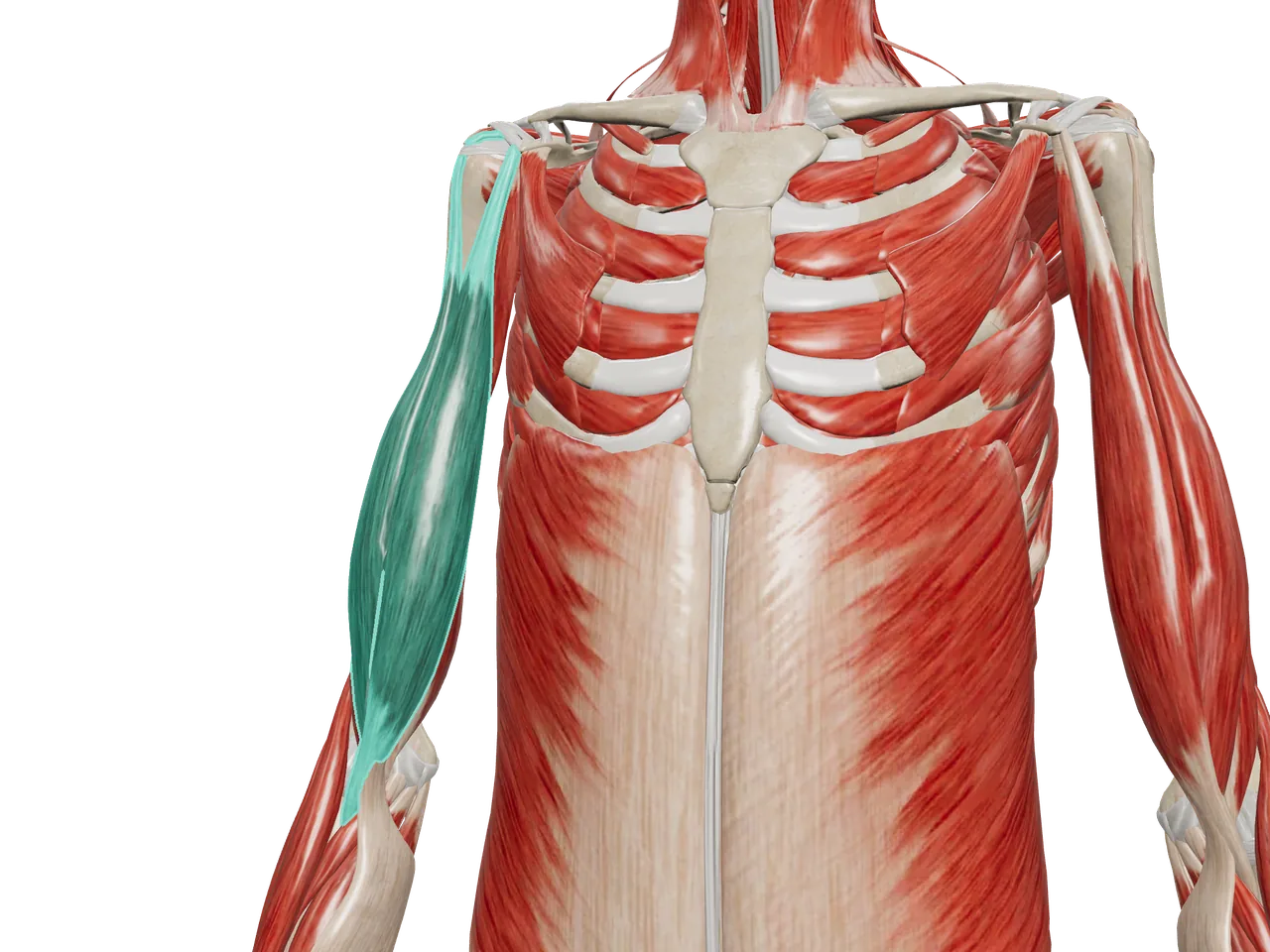
A structure in the 3D atlas. The facts below are the ones Watar holds for it, each with its source.
Facts
- Extrasynovial within the shoulder joint, the long head's tendon runs obliquely toward the bicipital groove; its length averages 9 cm. Origin: supraglenoid tubercle and superior glenoid labrum.
- The long head's tendon leaves the distal bicipital groove and meets the short head's tendon. In the upper arm's central third, each of the two tendons gives way to its own muscle belly.
- The distal biceps has two separate tendons. The short head attaches further distally on the radial tuberosity; the long head tendon passes deep to it and attaches more proximally.
- Flexes the forearm from the extended position, and once flexed is the forearm's strongest supinator.
- Chief arterial supply: muscular branches of the brachial artery, which can be palpated beneath the biceps.
- Musculocutaneous nerve, carrying both motor and sensory fibres; roots C5 and C6; a terminal branch of the lateral cord of the brachial plexus.
- Musculocutaneous nerve: starts at the lower edge of pectoralis minor, pierces coracobrachialis and descends between biceps and brachialis. Beyond the cubital fossa it continues as the lateral cutaneous nerve of the forearm.
- Long head: supraglenoid tubercle of the scapula. Short head: tip of the scapula's coracoid process.
- Posterior part of the radial tuberosity, plus the bicipital aponeurosis into the medial side of the forearm.
- Strong forearm supinator and elbow flexor; only a minor part in shoulder flexion.
- Bicipital aponeurosis: opposite the bend of the elbow the tendon gives off a broad sheet from its medial side. It crosses the brachial artery obliquely downward and medially and is continuous with the deep fascia over the origins of the forearm flexors.
- Arises by two heads. The short head arises by a thick flattened tendon from the apex of the coracoid process, together with coracobrachialis. The long head arises from the supraglenoid tuberosity at the upper margin of the glenoid cavity and is continuous with the glenoid labrum.
- The two bellies end in a flattened tendon inserted into the rough posterior part of the tuberosity of the radius, with a bursa between the tendon and the front of the tuberosity.
- Musculocutaneous nerve (C5-C7 in one source); another source traces the supply to C5 and C6.
- Flexes the elbow and, to a lesser extent, the shoulder. It is also a powerful supinator of the forearm, and through the lacertus fibrosus it tenses the deep fascia of the forearm.
Sources
- StatPearls: anatomy-shoulder-and-upper-limb-biceps-muscle
- StatPearls: anatomy-shoulder-and-upper-limb-arm-muscles
- Gray's Anatomy, 1918
- StatPearls: Anatomy, Head and Neck: Brachial Plexus
- OpenStax A&P 2e: Muscles of the Pectoral Girdle and Upper Limbs