Triceps brachii
The triceps brachii is the large muscle at the back of the upper arm, with three heads that join in one tendon ending on the olecranon of the ulna. It is the main extensor of the elbow and the direct antagonist of the biceps, and the radial nerve supplies it.
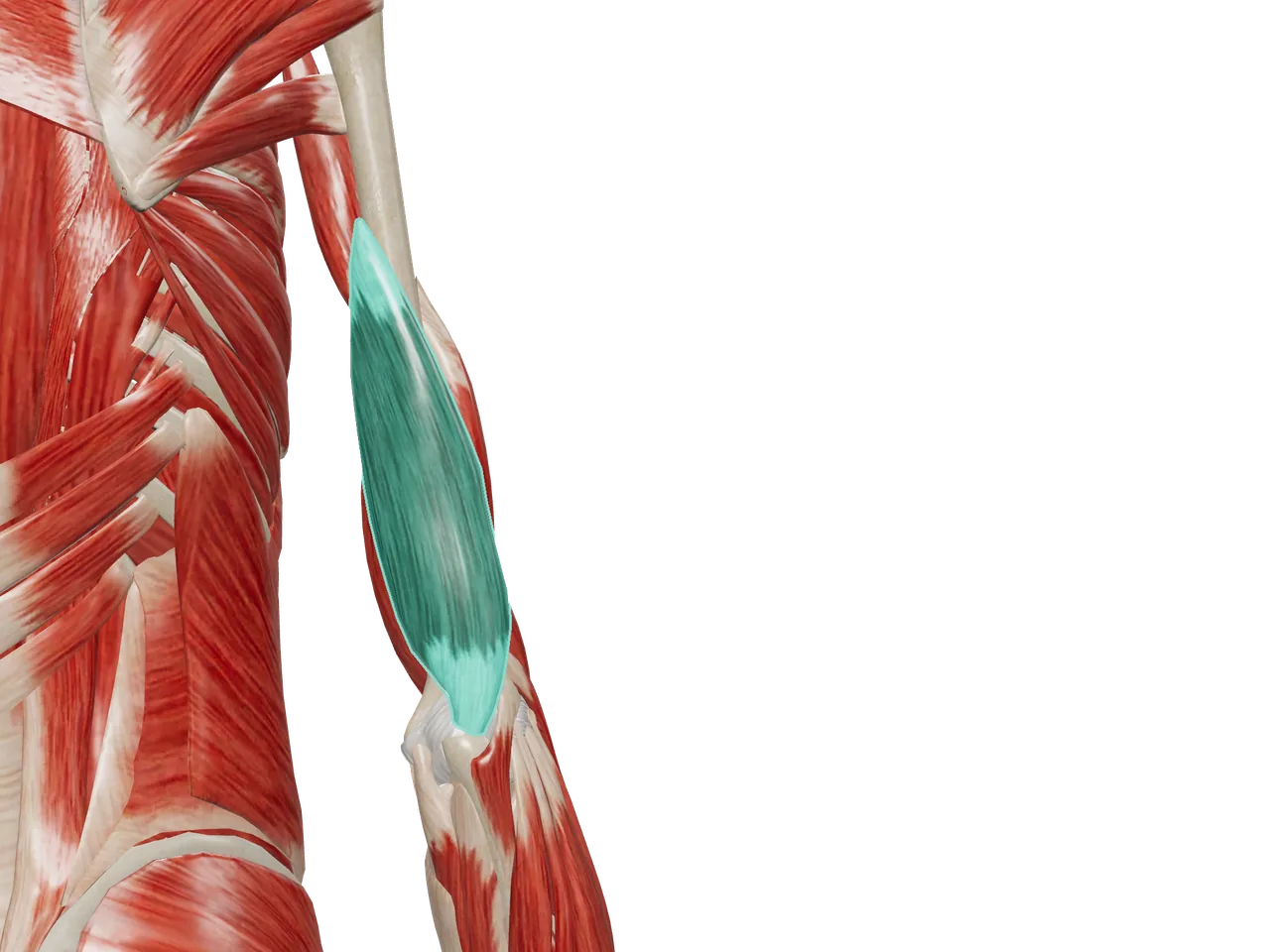
A structure in the 3D atlas. The facts below are the ones Watar holds for it, each with its source.
Facts
- All three heads join in one tendon that ends on the upper part of the olecranon of the ulna.
- Its scapular origin (infraglenoid tubercle) is why the long head acts slightly at the shoulder (glenohumeral) joint as well.
- Shoulder: long head assists arm extension and adduction. In the adducted arm, triceps keeps the humeral head in the glenoid cavity, guarding against displacement.
- Medial head: arises from the dorsal humerus below the radial groove, plus the intermuscular septum. With no scapular attachment, it cannot act at the glenohumeral joint, either to stabilise or to move it.
- Lateral head: dorsal humerus above the radial groove, blending with the lateral intermuscular septum. Regarded as the strongest of the three heads.
- Extends the forearm at the elbow, opposing flexors such as biceps brachii. Can also steady the elbow during fine forearm and hand work such as writing.
- Deep brachial artery, a branch of the brachial artery; drained by the brachial vein that runs alongside it.
- Radial nerve (C6, C7, C8). A cadaveric study found the medial head can be partly supplied by the ulnar nerve; other work indicates the long head can be partly supplied by the axillary nerve.
- Behind the humerus, in the radial groove between the lateral and medial heads of triceps brachii, the radial nerve follows its inferolateral route through the arm alongside the profunda brachii artery (the supply to the posterior arm).
- Deep brachial artery; posterior circumflex humeral artery.
- Olecranon of the ulna takes one common tendon from all heads. Long head: infraglenoid tubercle. Lateral head: humerus shaft, upper posterior half, above the spiral groove. Medial head: humerus shaft, lower posterior half, below the groove.
- Arises by three heads. The long head arises by a flattened tendon from the infraglenoid tuberosity of the scapula. The lateral head arises from the back of the body of the humerus between the teres minor insertion and the upper part of the radial groove. The medial head arises from the back of the body of the humerus below the radial groove.
- Its two tendon layers join above the elbow and are inserted, for the most part, into the posterior portion of the upper surface of the olecranon.
- The radial nerve, carrying fibres from the seventh and eighth cervical nerves.
- The great extensor of the forearm (elbow) and the direct antagonist of biceps brachii and brachialis.
Sources
- StatPearls: anatomy-shoulder-and-upper-limb-triceps-muscle
- StatPearls: anatomy-shoulder-and-upper-limb-scapulohumeral-muscles
- StatPearls: anatomy-shoulder-and-upper-limb-arm-muscles
- Gray's Anatomy, 1918