Gluteus maximus
The gluteus maximus is the largest muscle of the buttock, arising from the sacrum and the posterior ilium. Its fibres insert into the iliotibial tract and the gluteal tuberosity of the femur, and it extends and externally rotates the thigh, supplied by the inferior gluteal nerve.
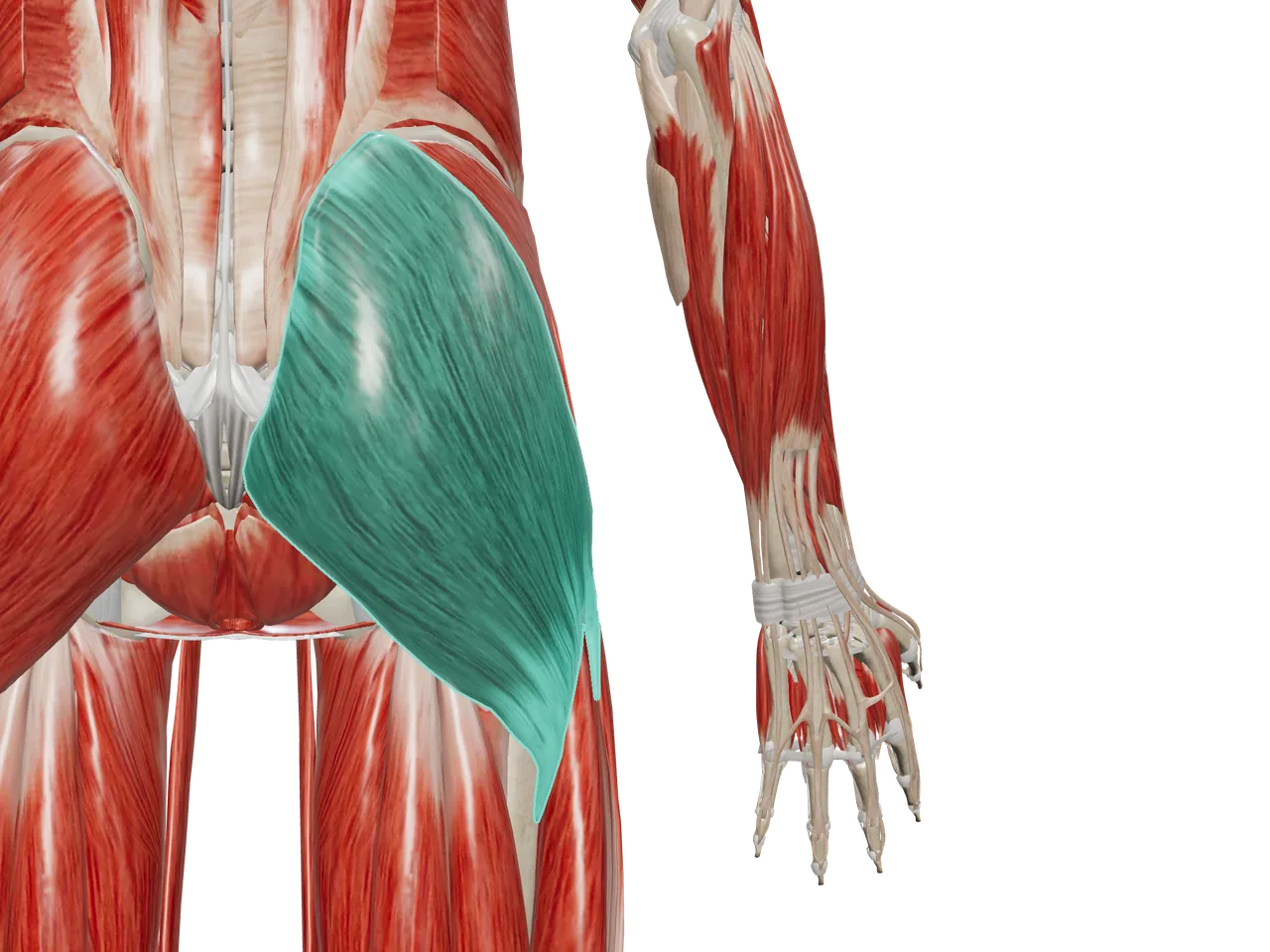
A structure in the 3D atlas. The facts below are the ones Watar holds for it, each with its source.
Facts
- Sacrum (lateral mass) and ilium (posterior part, behind the posterior gluteal line); soft-tissue origins also from the lumbar fascia and the sacrotuberous ligament.
- Two insertions: superficial fibres end in the iliotibial tract; deep fibres attach to the femur's gluteal tuberosity, between vastus lateralis and adductor magnus.
- Powerful extensor, but acts as one only when force is needed, together with semitendinosus and semimembranosus; examples: rising from sitting, straightening up from bending over, going upstairs, walking on a hill, running.
- Externally rotates the hip, with the obturator muscles and piriformis as synergists.
- Superior and inferior gluteal arteries.
- Inferior gluteal artery: runs down beside the sciatic nerve; supplies the superficial skin; anastomoses with the lower limb's perforating arteries.
- Inferior gluteal nerve (ventral rami of L5-S2), which supplies this muscle alone; emerges from the lower border of the piriformis.
- Arises from the posterior gluteal line of the ilium and the bone above and behind it including the crest, from the back of the lower sacrum and the side of the coccyx, and from the aponeurosis of the sacrospinalis and the sacrotuberous ligament.
- The upper, larger part and the superficial lower fibres end in a thick tendinous sheet that crosses the greater trochanter and inserts into the iliotibial band of the fascia lata; the deeper lower fibres insert into the gluteal tuberosity, between vastus lateralis and adductor magnus.
- Extension and external rotation of the thigh at the hip. Its most powerful action is to bring the body back to the erect position after stooping, by drawing the pelvis backward, assisted by the biceps femoris, semitendinosus and semimembranosus. The lower part also acts as an adductor and external rotator of the limb.
- Inferior gluteal nerve (dorsal branches, L5-S2), which emerges from the pelvis by way of the greater sciatic foramen, passing under piriformis.
Sources
- StatPearls: anatomy-bony-pelvis-and-lower-limb-gluteus-maximus-muscle
- Gray's Anatomy, 1918
- StatPearls: Anatomy, Back, Lumbosacral Trunk